
DVSA Show Me Tell Me Questions
DVSA show me tell me questions are a small but important part of the practical driving test. You will normally be asked one Tell Me question before driving and one Show Me question while driving. If you answer incorrectly, you will usually receive one driver fault, so these are easy marks to keep if you prepare properly.
- Full car question set in one place
- Simple answers to help revision
- Useful for test preparation and mock tests
- Easy marks when prepared in advance
These DVSA show me tell me questions are worth revising before test day. If you also want practical help, visit the driving test support page.
What are DVSA show me tell me questions?
DVSA show me tell me questions are basic vehicle safety questions asked as part of the UK practical driving test. They are there to check that you understand simple car checks and can use essential controls safely. The Tell Me question comes before you move off, while the Show Me question is asked during the drive.
Many learners lose an easy mark simply because they have not revised them. That is why it helps to go through the full list more than once, say the answers out loud and connect each answer to the actual control or check in the car. If you are preparing for test day more generally, you may also want to look at the beginner driving lessons page or your mock test preparation.
The full list below is designed to make DVSA show me tell me questions easier to revise, whether you are studying at home, practising with your instructor or doing a last review before your practical test.
Tell Me questions before driving
You will answer one of these at the start of the test. For bonnet questions, you may be asked to open the bonnet and identify the relevant area.
1) Tell me how you’d check that the brakes are working before starting a journey.
Brakes should not feel spongy or slack. Brakes should be tested as you set off. The car should not pull to one side.
2) Tell me where you’d find the information for the recommended tyre pressures for this car and how tyre pressures should be checked.
Recommended pressures are in the manufacturer’s guide or handbook, or on a label such as inside the door shut or fuel flap. Check using a reliable pressure gauge when tyres are cold. Do not forget the spare tyre if one is fitted.
3) Tell me how you make sure your head restraint is correctly adjusted for safety.
The head restraint should be adjusted so the rigid part is at least as high as the eyes or the top of the ears, and as close to the back of the head as is comfortable.
4) Tell me how you’d check the tyres to ensure they have sufficient tread depth and are safe to use.
There should be no cuts or bulges. Tread depth must be at least 1.6mm across the central three quarters of the tyre and around the entire outer circumference.
5) Tell me how you’d check that the headlights and tail lights are working. You do not need to exit the vehicle.
Turn on the switch, with ignition if needed. Check the warning light on the dashboard. If you needed to check physically, you would walk around the vehicle.
6) Tell me how you’d know if there was a problem with your anti-lock braking system.
A warning light should illuminate if there is a fault with the anti-lock braking system.
7) Tell me how you’d check the direction indicators are working. You do not need to exit the vehicle.
Operate the indicators or hazard warning lights and check the tell-tale warning lights on the dashboard. If physically checking, you would walk around the vehicle.
8) Tell me how you’d check the brake lights are working on this car.
Operate the brake pedal and make use of reflections in windows or doors, or ask someone to help you check.
9) Tell me how you’d check the power-assisted steering is working before starting a journey.
Apply gentle pressure to the steering wheel and start the engine. The steering should become noticeably lighter. If the system is faulty, the steering may remain heavy.
10) Tell me how you’d switch on the rear fog light(s) and explain when you’d use it or them. You do not need to exit the vehicle.
Operate the switch, with dipped headlights and ignition if needed. Check the warning light is on. Rear fog lights should be used when visibility is seriously reduced, usually less than 100 metres, and turned off when visibility improves.
11) Tell me how you switch your headlights from dipped to main beam and explain how you’d know the main beam is on.
Operate the main beam switch or stalk, with ignition if required. Check the main beam warning light on the dashboard.
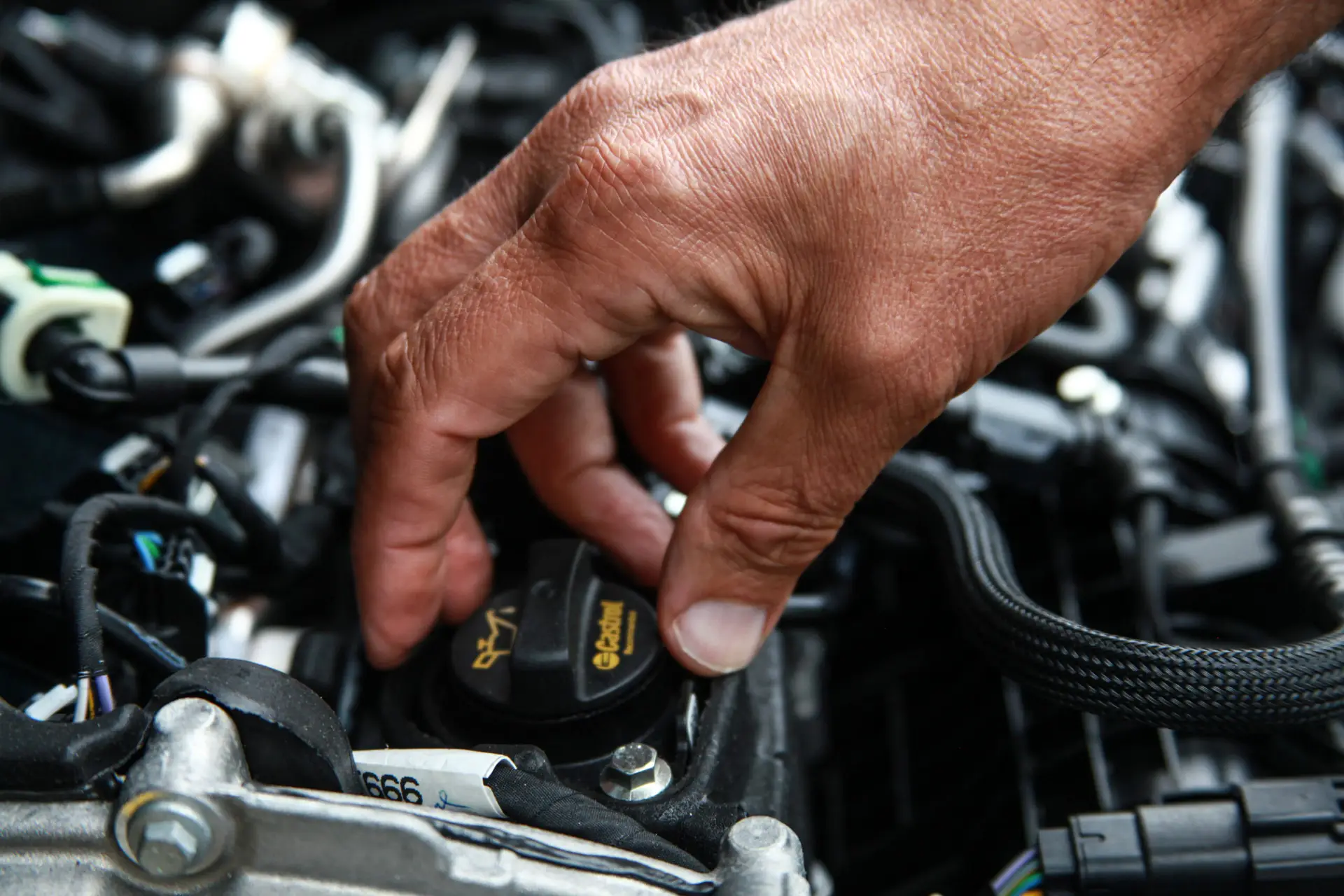
12) Open the bonnet and tell me how you’d check that the engine has sufficient oil.
Identify the dipstick or oil level indicator. Explain that you would check the oil level against the minimum and maximum markers on level ground with the engine off, ideally when cold.
13) Open the bonnet and tell me how you’d check that the engine has sufficient engine coolant.
Identify the header tank and explain checking the level against the high and low markings when the engine is cold. Do not remove the cap when the engine is hot.
14) Open the bonnet and tell me how you’d check that you have a safe level of hydraulic brake fluid.
Identify the brake fluid reservoir and explain checking the level against the high and low markings, or minimum and maximum marks. It should be within the safe range.
Show Me questions during driving
The examiner will ask you to demonstrate one of these while driving. With DVSA show me tell me questions, it is perfectly acceptable to say “when it’s safe” and then carry out the action once you are in a suitable position.
1) When it’s safe, show me how you wash and clean the rear windscreen.
Operate the rear wash and wipe control.
2) When it’s safe, show me how you wash and clean the front windscreen.
Operate the front wash and wipe control.
3) When it’s safe, show me how you’d switch on your dipped headlights.
Operate the dipped headlight control while keeping your attention on the road and maintaining control of the vehicle.
4) When it’s safe, show me how you’d set the rear demister.
Switch on the heated rear window control.
5) When it’s safe, show me how you’d operate the horn.
Press the horn briefly when safe and appropriate.
6) When it’s safe, show me how you’d demist the front windscreen.
Set the controls to direct air to the front windscreen. This may include the front demist setting, fan speed, temperature and air conditioning if needed.
7) When it’s safe, show me how you’d open and close the side window.
Operate the electric window switch or manual winder while maintaining full control of the vehicle.
Quick test tip
A good habit with DVSA show me tell me questions is to say: “When it’s safe”. That shows you understand control and safety come first.